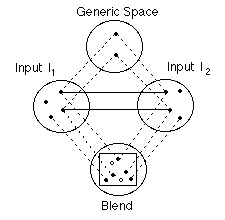
Conceptual Integration, otherwise known as "blending,"
is a defining feature of higher-order human cognition, indispensable
for all behaviors typically taken as distinctive to human beings.
This course presents the cognitive mechanisms of conceptual
integration, the constraints on its operation, and its deployment
and expression in a range of human behaviors such as learning,
invention, mathematical and scientific discovery, language,
art, music, gesture, social understanding, institutional performance,
reasoning, decision, judgment, choice, design, and engineering.
A student in the class will work on an individual research project
in any of a variety of fields, including engineering (e.g.,
designing with blends), computer science, the arts, the humanities,
the social sciences, cognitive neuroscience, and linguistics.